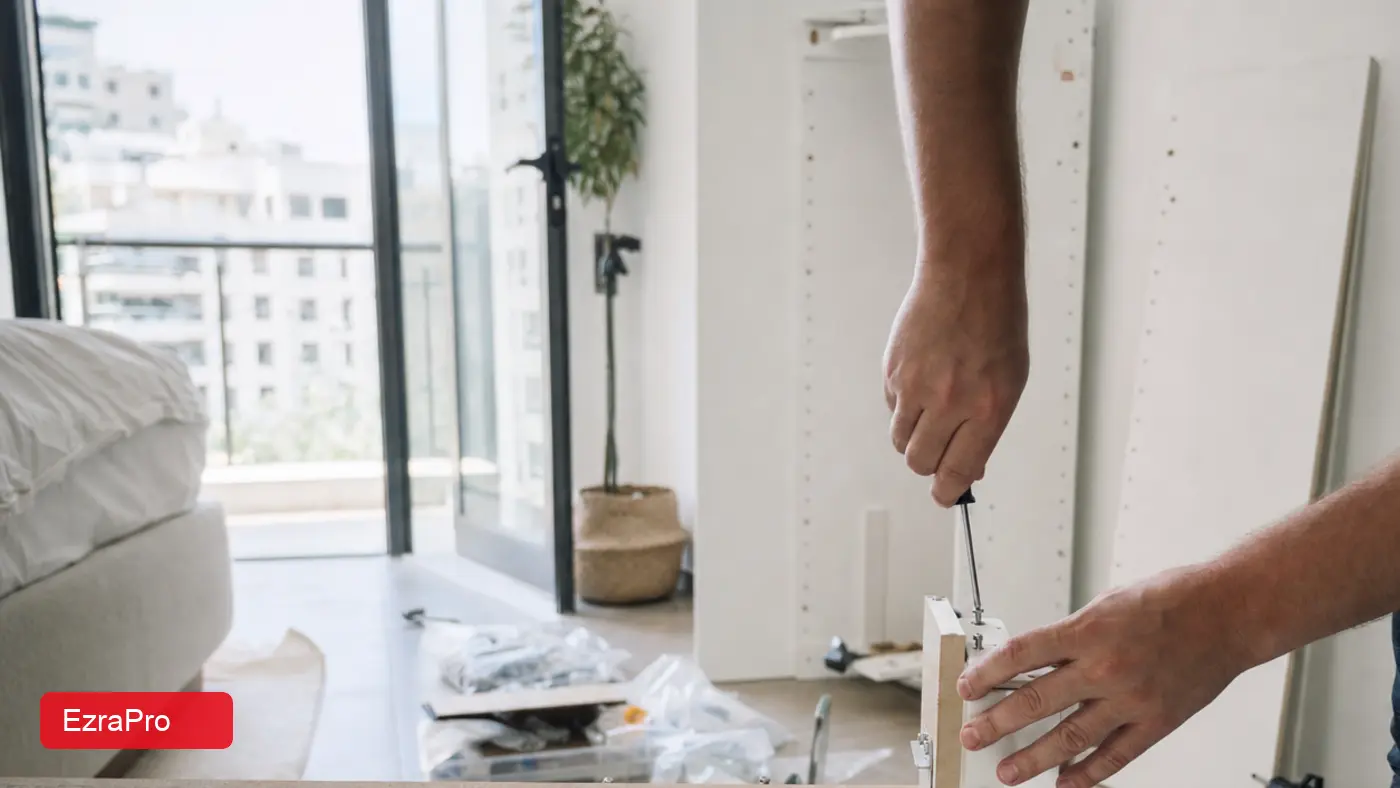
People often ask how much furniture assembly costs, but the real answer depends on what exactly needs to be built and under what conditions. In Israel, quotes are usually shaped by complexity, access, fitting requirements and any extra tasks beyond basic assembly.
Related read: what affects furniture assembly pricing.
Why there is no single price for furniture assembly
Furniture assembly sounds like one standard service, yet two jobs with the same label can be very different in practice. A simple bed frame in an empty bedroom is not the same as a tall wardrobe assembled in a tight room with limited clearance and uneven walls.
That is why a serious quote is based on the actual job rather than the product name alone. The assembler will usually look at the type of item, number of boxes, hardware, manufacturer instructions and how easy it is to work safely in the space.
There is also a major difference between brand-new flat-pack furniture and reassembly after a move. Reassembly often involves worn fittings, missing screws, damaged panels or alignment issues, which means more troubleshooting and slower progress.
- The item type matters more than the generic service name
- Box count and hardware affect labour time
- Reassembly after a move is usually more demanding
What usually affects the quote in Israel
The biggest factor is complexity. A basic desk, chest of drawers or standard bed is a different job from a sliding wardrobe, modular storage system, children’s room set or anything with multiple doors, rails and adjustment points.
Fine alignment also matters. If the job includes levelling doors, adjusting drawer runners, setting fronts evenly or making the piece sit correctly against imperfect walls or floors, the work becomes more precise and time-consuming.
Wall fixing can change the scope as well. In Israeli homes, wall materials vary, so the professional may need to check whether drilling is suitable, what anchors are needed and whether there are any installation risks in that area.
If several items are booked together, the quote may reflect the total scope and workflow. A full day in one flat is easier to plan than multiple small call-outs to different addresses.
- Design complexity and number of sections
- Adjustment of doors, drawers and fronts
- Wall anchoring and drilling conditions
- Overall scope of the booking
Extra tasks that can change the final scope
Clients often think only about assembly, but the visit may include much more. Heavy boxes may need to be carried upstairs, old furniture may need to be moved or dismantled, and the room may need to be cleared before work can even begin.
Some tasks are commonly treated as add-ons rather than part of basic assembly. These can include wall mounting shelves, changing standard hardware, fitting handles, drilling extra holes, making on-site adjustments or removing packaging after the job.
Kitchen units and built-in style furniture are a separate level of work. They may involve measuring, joining modules, working around sockets, pipes or appliances, and making sure the final installation is neat and usable in a real home setting.
To avoid confusion, it helps to list everything you expect during the visit before the professional arrives. The clearer the brief, the easier it is to understand what the quote covers and what sits outside the base service.
- Carrying boxes and clearing the room
- Dismantling old furniture
- Wall mounting and drilling
- On-site adjustments and packaging removal
How to get a useful estimate before booking
The best approach is to send product links, model numbers, box photos and a few pictures of the room. That gives the assembler enough context to judge size, complexity and any likely access or fitting issues before the visit.
It is also worth mentioning the floor, lift access, parking situation, whether boxes must be carried manually and whether wall fixing is required. These details can materially change the time and planning involved.
You should also agree on what counts as job completion. For some households, assembled means the item is standing in place. For others, completion includes full adjustment, wall anchoring, mechanism checks and removal of packaging.
If a quote feels vague, ask for a breakdown by stage: assembly, installation, wall fixing, dismantling and waste removal. That makes it easier to compare professionals on scope rather than on a headline figure alone.
- Send links, model details and room photos
- Clarify access, lift and carrying conditions
- Define what completion includes
- Ask for a scope breakdown, not just a headline quote