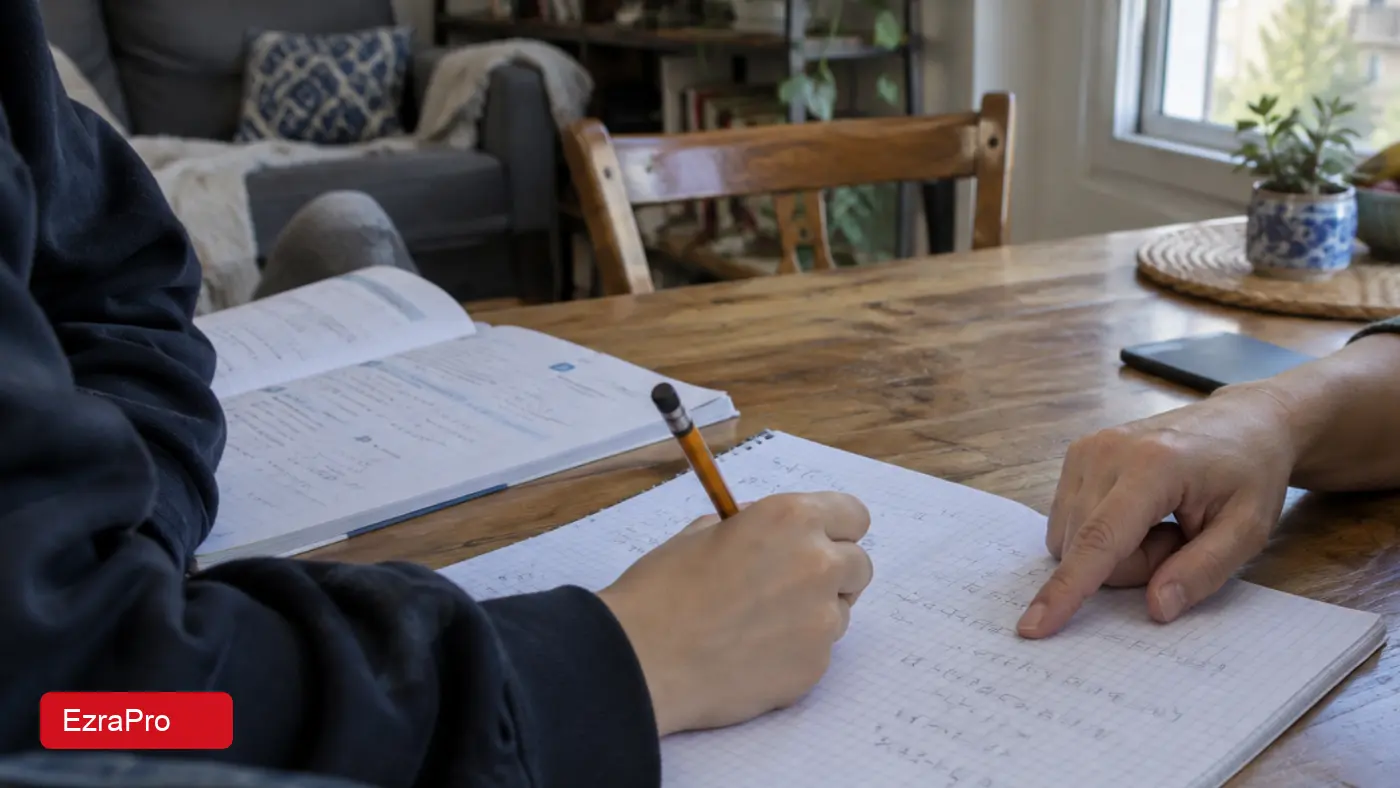
When a student still cannot explain the material, avoids homework or starts feeling anxious before lessons, continuing automatically is rarely useful. Gather specific examples, discuss them with the tutor and agree on a practical change that can be reviewed.
Related read: how maths tutor quotes are shaped in Israel.
Define what “not helping” means
A lack of progress can look different from student to student. Test results may not change, explanations may be too advanced, the student may forget the work between lessons, or the real issue may be confidence rather than the subject itself. Write down a few concrete examples: a topic, a type of exercise, a repeated mistake and the point where the student gets lost.
Review the surrounding conditions too. Was the goal clear? Does the tutor know the student’s starting level? Is there time for practice between sessions, and are lessons regular enough? A tutor preparing someone for a school test, an entrance exam or learning in a second language needs a target that is specific to that learner, not just a general syllabus.
- Ask the student which step of the explanation is unclear.
- Check for missing foundations before adding harder material.
- Separate a delayed result from a worsening learning experience.
How to raise the issue with the tutor
Use observations rather than accusations. You might say: “After the last few lessons, the student still cannot solve this type of problem or explain the main step. What do you think is causing it, and what would you change next?” This gives the tutor a chance to explain the method and suggest an adjustment.
Ask for a near-term learning goal, a way to check it and a clear expectation for practice at home. A responsible tutor does not need to promise a particular grade, but should be able to explain what skill is being built and what will happen if the approach is not working. Vague replies or blaming the student for every difficulty are reasons to reconsider the arrangement.
- Confirm the revised plan in writing.
- Ask for a brief update after lessons.
- Make sure homework fits the student’s level and available time.
What if the tutor shouts?
Shouting, mocking, insults and intimidation are not acceptable teaching methods. Subject expertise does not compensate for making a student feel unsafe or ashamed of mistakes. The student should be able to stop the lesson and tell a parent or another trusted adult what happened.
If it was a single incident, an adult may set a direct boundary and ask whether the tutor is willing to change. If shouting, humiliation, threats or serious anxiety continue, stop the lessons. Keep messages and make a factual note of the date and circumstances, especially when the tutor was booked through a marketplace or agency.
- Do not leave the child to manage the conflict alone.
- Do not continue only because a lesson has already been paid for.
- If there is an immediate safety concern, contact the appropriate emergency service.
When to find a different tutor
Changing tutors makes sense when a clear conversation produces no change in teaching method, communication or fit. It is also reasonable when the tutor repeatedly arrives late, cancels without agreed rules, comes unprepared or ignores a documented learning need. The goal is not to find someone who never challenges the student, but someone who can challenge them without undermining them.
Before a trial lesson with someone new, define the subject, the student’s level and the immediate goal. Ask how the tutor assesses gaps, explains errors, adapts exercises and reports progress. For tutoring in Israel, also agree on the teaching language, online or in-person format, schedule and cancellation rules; these details often matter as much as subject knowledge.
- Bring notebooks, tests and a list of difficult topics.
- Look for a clear process rather than a promise of guaranteed results.
- Agree on communication and rescheduling before the first regular lesson.
Payment and service expectations
If you end the arrangement, review what was agreed about individual lessons or packages, cancellations, postponements, trial sessions and unused lessons. Keep the messages, payment confirmations and service terms. If the tutor came through a platform, contact its support channel with a concise timeline and supporting records.
Tutoring fees generally reflect the subject, level, tutor experience, format, urgency and amount of preparation or feedback. Compare the full service rather than a headline rate: assessment, lesson preparation, practice materials, availability and progress tracking can all affect what a quote includes.